
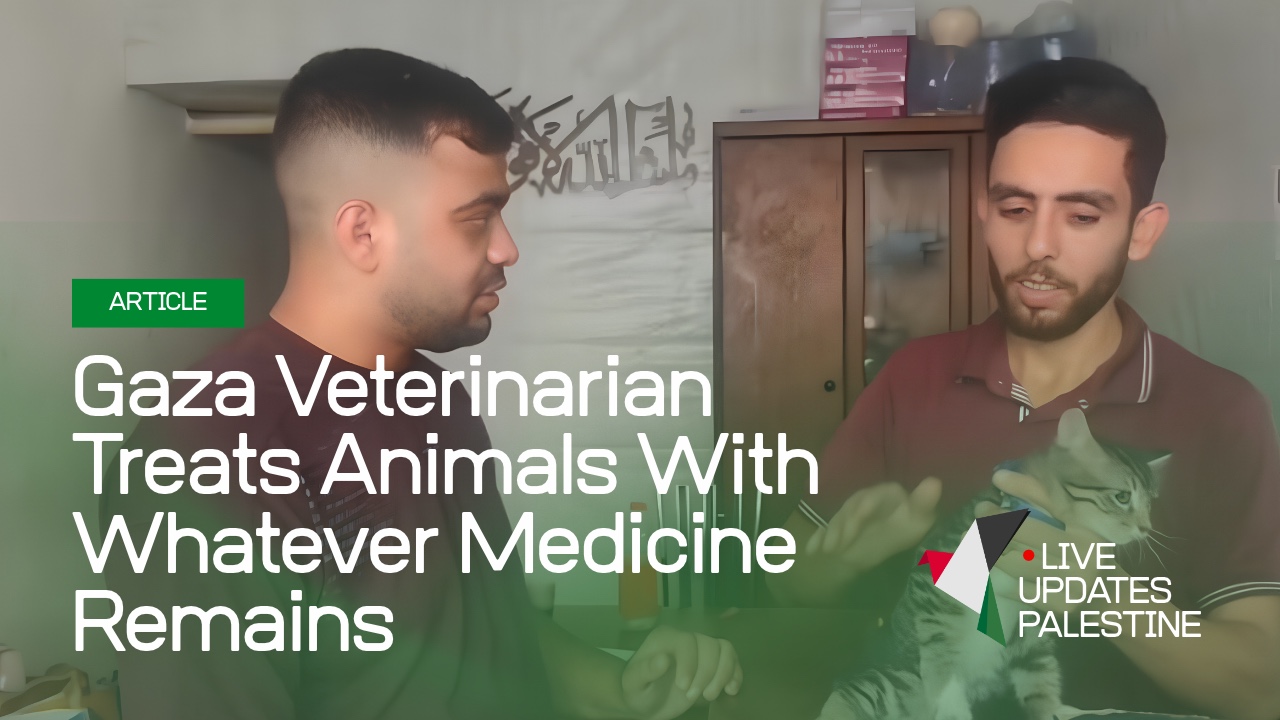
Shortages of vaccines, equipment and electricity leave the few vets still working in northern Gaza struggling to save animals
By Nesma Al-Harazeen, Gaza City
GAZA CITY — As war has left people in Gaza facing fear, injury and displacement, veterinarian Mutasim Qadura is confronting another, quieter form of suffering: sick and injured animals that cannot get care because veterinary medicines and vaccines are increasingly hard to obtain.
Dr. Qadura kept working throughout the war, even as many veterinarians left, supplies dwindled and electricity became unreliable. In northern Gaza, his family home became a refuge for pet owners with nowhere else to turn.
The medical instruments he once relied on have disappeared. In some cases, he said, he has had to use human medicines or old veterinary drugs because no alternatives were available.
Dr. Qadura studied veterinary medicine in Jordan on an Al-Fakhoora scholarship, choosing the field because of a clear need for specialists. The war, he said, turned a vet used to working with proper equipment into someone who must first search for medicine and then find a way to deliver treatment.
Caesarean on a kitchen table
One case stands out. A cat’s owner brought the animal to Dr. Qadura after it developed complications during labour.
There was no properly equipped clinic, no reliable electricity and only a small amount of anaesthetic left. Dr. Qadura nonetheless performed a Caesarean section on a table inside his family home, saying there was no time to wait for better conditions.
The owner also chose not to have the cat’s uterus removed during the operation, given the sharp fall in the number of cats in the area since the war.
The cat survived, as did her kittens. Dr. Qadura said she has since recovered and is pregnant again.
He described the operation as more than a successful procedure. It was a reminder, he said, that his work can still give life a chance in a place where war has put almost every form of life under pressure.
Shortages of medicines and vaccines
Dr. Qadura said shortages of veterinary medicines and vaccines are among the biggest challenges facing vets in Gaza.
Vaccines, particularly those that need refrigeration, have not been allowed into Gaza in the quantities required, he said, while medicine supplies have fallen far below what animals need. Small amounts are sometimes brought in by travellers, but it is far from enough.
With supplies running low, he has relied on whatever remains, including old or expired veterinary drugs when there is no other option.
Some animals have died because the necessary medicines were unavailable, he said. Vets can sometimes only stand by helplessly when animals develop viral illnesses they lack the tools to treat.
The lack of vaccines, he added, also increases the risk of diseases and viruses spreading.
Livestock devastated by war
Gaza’s animals have not been spared. According to Dr. Qadura, the poultry sector has suffered enormous losses, sheep numbers have fallen sharply and cattle have become almost nonexistent.
Pet animals have also vanished. Some left with families forced to flee their homes, while others became strays after being separated from their owners during displacement.
The role of vets has become more important even as the tools they need have become scarcer. Dr. Qadura returned to work after the war because the need for veterinary care had grown, particularly after many veterinarians left. In northern Gaza, only a small number of specialists remain, and he is among those still receiving cases.
Stitching wounds and providing first aid
During the war, Dr. Qadura’s work extended beyond animals. He helped residents by stitching wounds and providing first aid where he could, while continuing to treat animals whenever possible.
Many of his surgical instruments disappeared, electricity was unreliable and his medicine supplies shrank day by day. He still performed surgery whenever there was a chance of saving an animal.
“What keeps me going is serving the people,” Dr. Qadura said, adding that the feeling that people needed him kept him working. Returning to veterinary medicine, he said, was an attempt to fulfil the role he chose when he first decided to study the subject.
Calls for vaccines, refrigeration and laboratories
Dr. Qadura said the crisis cannot be solved by supplying medicines alone.
He is calling for veterinary vaccines, particularly those that require refrigeration, along with refrigerators and a reliable electricity supply to store them safely.
He also wants specialised laboratories able to monitor infectious diseases that affect animals and could threaten human health. Without laboratory surveillance, he said, detecting and controlling outbreaks becomes far more difficult.
He hopes animal disease monitoring and survey programmes can be restored, arguing that protecting animals is also part of protecting the wider community.
Working from a family home
Dr. Qadura does not have the well-stocked clinic or equipment he might once have imagined. He has what remains of his medicines, a few tools, years of training and a determination not to turn away animals brought to him.
Dr. Qadura said he is a veterinarian and his job is to treat animals, which is why he went back to work with whatever was available, even under the most difficult circumstances.
From a small space inside his family home, he treats wounds, helps animals give birth and tries to save injured animals with the medicine that is left. Medicines are scarce, electricity is intermittent and medical equipment has become a casualty of war.
His mission, he said, has not changed: to treat with what he has and keep serving people and animals, even when almost nothing remains.