
By Nesma Al-Harazeen, Gaza City
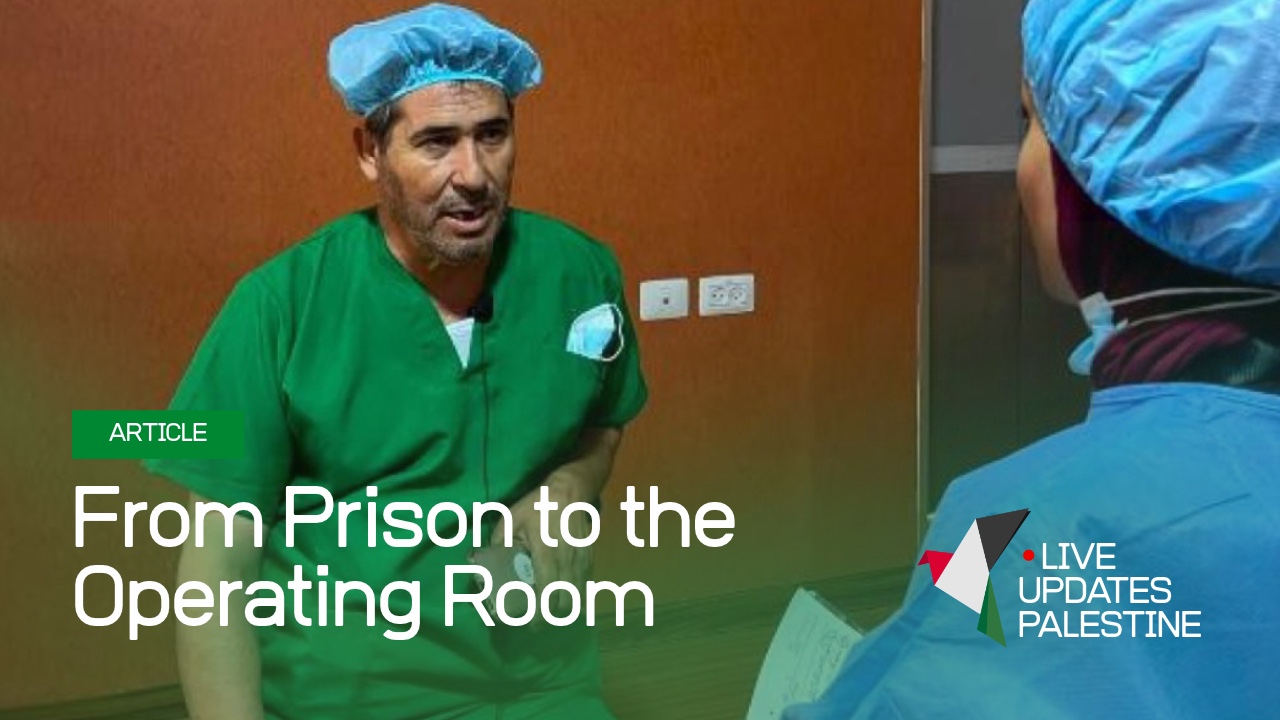
GAZA CITY — Dr. Issam Abu Ajwa, a general surgeon, was back at work in a Gaza hospital within hours of his release from about eight months in Israeli detention, determined to keep operating despite injuries to his hands that he says were inflicted during interrogation.
Inside the Arab Baptist Hospital in Gaza City, the smell of disinfectant mixed with blood amid ventilators and resuscitation equipment. Bandages were scarce and bleeding was constant. Abu Ajwa, he said, had no time to think about his own safety.
From the first hours of the war, he went directly to the hospital, where general surgeons could be counted on one hand. More than 200 dead and wounded arrived from eastern Gaza, including the Zeitoun, Shuja’iyya and Daraj neighbourhoods.
A retired surgeon of the Palestinian Health Ministry, Abu Ajwa returned to the operating room as an unpaid volunteer when the number of surgeons fell to critical levels.
“I started the war as a volunteer, working hard for the injured patients because there were very few surgeons,” he said.
The hospital itself came under attack. Israeli forces struck it on Oct. 17, 2023. The Palestinian Health Ministry said at the time that 500 people were killed and hundreds more wounded, describing it as the deadliest incident in Gaza since the war began.
Medical staff said a particular type of bomb had caused unprecedented injuries. Body parts and the remains of children and other victims were found across the hospital buildings, and medical teams transferred many of the wounded to Al-Shifa Hospital in Gaza City.
“The hospital grounds and its terraces turned into a river of blood,” Abu Ajwa said. “We were receiving the remains of the dead. Artillery shells shook the operating rooms. We ran to the scene. Most of the victims were children, women and elderly people.”
Hospital Under Siege
By Nov. 15, 2023, the Arab Baptist Hospital was the only functioning hospital in northern Gaza amid the Israeli ground operation, effectively serving as a first-response station for hundreds of wounded people.
On Nov. 16, the Palestine Red Crescent Society said Israeli forces, including tanks, had imposed a complete siege on the hospital for several days, preventing medical teams from reaching and treating the wounded. The siege entered a second day on Nov. 17 and a third on Nov. 18, amid heavy shelling and gunfire, with Red Crescent teams trapped inside and unable to reach people outside.
“We worked intensively for 72 hours without sleep or food,” Abu Ajwa said.
The hospital did not close its doors. Staff cleaned wounds by the light of mobile phones and sterilised instruments with the limited water available, operating day and night while trying to supply patients with the basics of survival.
“We cooked rice and bread inside the hospital so that doctors and patients would have something to eat, amid the war and the siege imposed by the occupation forces and their tanks,” he said.
Arrest in the Operating Room
Dec. 18, 2023, remains etched in Abu Ajwa’s memory. Intense bombardment hit Omar Al-Mukhtar Street, next to the hospital, before Israeli forces surrounded the building from all sides and cut it off. Patients, wounded people and doctors sheltered behind what remained of the walls.
Abu Ajwa and a small team were operating on a 3-year-old boy, his family’s only child, whose internal organs were outside his abdomen. Israeli forces used loudspeakers in the courtyard to order the doctor and the rest of the medical staff to come outside. He stayed at the operating table.
“Humanity took over me and I remembered my children,” he said. “So I stayed and continued the operation on the child. The soldiers were calling through loudspeakers, but we did not leave the operating room. I stayed until we were sure the child was safe, despite the shortage of medicines and basic medical supplies.”
As the surgery ended, soldiers stormed the operating rooms and pulled him away, still in his bloodstained surgical uniform. He was arrested in front of his family, who had been displaced to the hospital, and in front of patients, along with several doctors and the nurse who had worked beside him.
He was taken out of the hospital amid the sounds of patients, soldiers and aircraft, knowing he was being taken far away but not where. He realised then, he said, that surgeons themselves had become targets of the Israeli military.
Months in Detention
Abu Ajwa said he and those held with him were blindfolded, restrained at the hands and legs, thrown to the ground and beaten. Interrogators insulted them, he said, including by calling them “animal.”
He described the detention as resembling a kidnapping by a group operating under the Israeli military. Detainees were denied food for long periods, forbidden from speaking or whispering to one another, made to sit on chairs without bending over, and subjected to severe beatings, harsh interrogation and continuous humiliation, he said.
“The hardest days were in Sde Teiman detention centre, in a tightly sealed room, with disturbing noises around the clock,” he said. “The floor was covered with gravel. You could not walk, sit or pray. They sprayed cold water on us during cold weather, and we had no clothes other than the single prison uniform.”
On one cold December morning, he said, he asked a jailer for a toothbrush because he was in pain from fractures caused by beatings. “He brought me a toilet brush instead and beat me again,” he said.
For eight months he had no news of his family, and they had none of him. A photograph of them at the time of his arrest stayed with him throughout. Recalling his final days in prison in January, he said: “I asked to take a shower so I could perform my religious duties. The jailer forced me to take off my clothes and shower in cold water at 5 a.m.”
Release and Return to Work
Abu Ajwa was placed in a closed vehicle, blindfolded, with his head covered and hands restrained, alongside other detainees. He said the driver deliberately drove over bumps while the metal seats heated in the sun. He was returned to Sde Teiman, expecting another interrogation, but the next morning the detainees were ordered onto an Israeli military bus coordinated by the International Committee of the Red Cross.
On July 1, 2024, after about eight months in detention, he was released. He found himself lying on the ground in Deir Al-Balah and got up without knowing exactly where he was, but aware that he was free.
Asked where he went first, he answered: “To Al-Aqsa Martyrs Hospital in Deir Al-Balah.” He added: “I did not spend much time thinking. I asked people in the street which way the hospital was. I reached the hospital and immediately returned to work after leaving detention.”
The hospital’s administration welcomed him back. He said he was struck on the arm during interrogation, and the marks remain visible on his wrist. He can no longer hold some instruments, including a scalpel, as he once did.
“The interrogator who beat me in prison told me he would prevent me from returning to work as a surgeon,” he said. “But I told him, while he was torturing me, that I would return to work immediately if I were released.” The interrogator laughed and beat him more violently, he said.
His words, he said, were not a challenge but a promise he had made to himself.
A Reunion After Nearly a Year
Even after his release, Abu Ajwa did not know where his family was or whether they were safe. Months later a relative told him they were still in northern Gaza, trapped by a barrier erected by the Israeli army separating the north of the Strip from the south. Only then did he learn his wife and children were alive.
“I heard the voice of my daughter Zainab, 13, over the phone as soon as I obtained her mobile number,” he said. “I could not hold back my emotions. I cried, and she broke down in tears.”
He has two daughters, aged 18 and 15, and two sons. One son is a fourth-year medical student in Gaza; the other graduated from secondary school in 2026 and hopes to study medicine.
During the first ceasefire in January 2025, Abu Ajwa travelled from the south to the north and saw his wife and children for the first time since his arrest. The emotions, he said, were a mix of pain, grief, joy and shock.
Lasting Scars
“The sound of aircraft takes me straight back to the detention centre and the moment of the raid,” he said. “I still suffer from anxiety and fear. My wife notices changes in my sleep and eating habits.”
He also lives with fractures and pain in his hands and legs and can no longer perform operations alone as he once did. He is undergoing physiotherapy and treating himself. He copes with his memories through prayer. “Whenever I remember how the interrogators treated me to make me hate my profession, I immediately turn to prayer,” he said.
At the Baptist Hospital, patients’ attachment to him and the respect of colleagues are evident; he is regarded as a beloved figure whose presence brings reassurance.
“I feel a greater responsibility towards the patients, as if I am in a challenge,” he said.
Asked about the hardest moments of his life, he pointed to the death of a friend in front of him while they were working, when he could not give medical help because shells were falling around them.
Asked whether he would leave Gaza to work and settle elsewhere, he was firm. “No. I will not leave my homeland and go away. Those who leave are the occupiers, not the people of the land.”
“A Doctor Was Created to Serve Patients”
Today Abu Ajwa continues to operate, carrying the physical scars of detention, loss and displacement. His hand still hurts when he grips certain instruments, and his memory replays the sounds of aircraft and the detention centre. He still wears his white coat as a declaration of defiance that he has not lost his profession.
“A doctor was created to serve patients,” he said.
In closing, he appealed to the world and international organisations. “What we want from the world and international organisations is justice for Gaza and the right of its people to live. A ceasefire has not ended the suffering. The crossings remain closed, medicines are in short supply, and bombardment and injuries continue. Hundreds of patients need treatment outside Gaza.”